Congress, the agencies, the statehouses and the city halls: appropriations, executive orders and the official explanation, every party equally.
Monday, November 2, 2026
Amarillo
Made Where, Exactly
The Potter County Republican Party has asked a federal court in Amarillo to block certification of Tuesday’s Texas results until every ballot is counted by hand, citing artificial intelligence and voting machine parts made by foreign adversaries such as China. Texans cast 8.1 million ballots in the 2022 midterms. The suit does not say where the pencils were made.
Tarrant County, Texas, cut nearly half of its Election Day polling locations earlier this year, Votebeat reports, and voters there are now turning out in record numbers. The long lines have eased in the past few days. The county has achieved record attendance at every polling place by the simple method of having fewer of them.
Homeland Security Secretary Markwayne Mullin told staff at CISA, the federal cybersecurity agency, that he plans a “debrief” after the midterms to review election security, Government Executive reports. One Arizona official said the state had no CISA cybersecurity adviser from March 2025 until recently, too late for some preparations. Federal election support now keeps a reliable timetable: it arrives just after it was needed.
The federal personnel office, OPM, has finalized a rule ending the 52-week time-in-grade requirement for General Schedule promotions at GS-6 and above, Government Executive reports. It was finalized on October 19 and takes effect January 19, 2027. Before federal employees can stop waiting a year, the rule must serve three months in grade.
The State Department will soon take applications for a pilot that admits people to the Foreign Service’s mid-career ranks without prior experience. About 250 of its diplomats got layoff notices last year; none will be reinstated. The pilot plans about 35 hires, then 30 a year. At that pace the 250 are replaced in about eight years, when the recruits will have the experience the program let them skip.
Massachusetts goes to the polls on Tuesday with a record-tying nine statewide ballot questions, The Boston Globe reports, one of them putting the Legislature under the public records law; lawmakers have advanced a bill that could blunt it. Only 57 of the Legislature’s 200 races are contested. With 143 seats unopposed, the ballot questions are the last opponents the Legislature has left.
The US Department of Homeland Security has issued a final rule letting people pay Freedom of Information Act request fees electronically, “through pay.gov or another electronic payment platform designated by DHS,” to reduce the work of handling paper payments. The rule “takes effect 30 days after publication.” Paying in seconds becomes possible in thirty days.
California’s Assembly Bill 181 gives its public schools a single governor-appointed commissioner, replacing a structure shared by the elected superintendent, the state board, the governor, the Legislature, local boards and about a dozen others. “It was everybody and nobody,” says a former board head. Everybody and nobody has become somebody, who can start with Los Angeles Unified’s latest plan, all of nearly 800 pages.
America’s General Services Administration has published its first count of how fully federal buildings are used, against a 60% benchmark. Congressional auditors at GAO report that 155 entirely vacant buildings and leases, 4.6 million usable square feet, were missing from it. GSA says it is “in full compliance” with the law. An empty building cannot miss the benchmark if nobody counts it.
Tennessee’s comptroller has approved Shelby County’s 2027 budget, having rejected the county’s budgets five years in a row, WMC Action News 5 reports. In July the county borrowed $125 million, mainly to make payroll, its second loan in seven months. The budget took six years to satisfy the state; the payroll took two loans to reach payday.
America’s National Nuclear Security Administration has gone from nearly 2,000 federal employees to 1,755, and one site’s security office lost about 40% of the staff doing nuclear material security work, the Government Accountability Office found. Officials look to artificial intelligence, though auditors record “limitations on how artificial intelligence can currently be used based on staff expertise.” The machine brought in to replace the experts is waiting for an expert.
America’s Small Business Administration intends to move field offices out of city centers next year, from Boston to Southborough, Mass., and from Washington to Herndon, Va., its employees’ union says. The agency, which has shed about 35% of its headcount since 2024, calls the new sites “less costly, more accessible communities.” They are certainly more accessible to Southborough.
America’s Office of Personnel Management holds a virtual hiring fair on 29 October, where 16 agencies will interview early-career candidates and make offers on the spot. Director Scott Kupor calls it “a hire-palooza.” An OPM spokesperson says the event is only for applicants already in the hiring process. Like most festivals, the palooza is open only to people who already have tickets.
Dallas’s city charter requires an audit of the city auditor’s own accounts when he leaves, so after the last one resigned in March, the City Controller’s Office checked his purchases, his final paycheck and whether he had returned his badge and parking pass. All three answers were yes, with “no reportable observations or recommendations.” After seven years of writing recommendations for everyone else, the auditor left with none of his own.
America’s Agriculture Department is going “full-bore ahead” with a reorganization that relocates about 2,600 employees, Secretary Brooke Rollins says, although a federal judge’s stay bars moves outside local commuting areas. One employee says his own request to relocate, at his own expense, was denied because of the stay. Of all the moves the department wants, the only one ready to go is the one it never asked for.
An Energy Department inspector general audit of Battelle Energy Alliance, which runs Idaho National Laboratory, questions over $30.5 million in award fees. The fee is the department’s incentive for good work; auditors found Battelle had entered it as a cost in its administrative pool. Battelle does not concur. Booked that way, the taxpayer reimburses Battelle for the trouble of being rewarded.
Allegheny County’s 15 council members share three full-time staffers, and the home rule charter bars spending county funds on more. A 3 November referendum asks whether to repeal that bar; council spending would stay capped at 0.4% of county property tax revenue. Until then each member has a fifth of an aide, enough to take a message and not quite enough to return it.
Oregon’s Deschutes County says its printed voters’ pamphlet dropped the letter “H” from the surname of a county commission candidate, and about 200 voters in newly annexed parts of Bend were mailed the wrong precinct ballots. The clerk’s office “regrets the errors” and has corrected the online pamphlet. The H has been restored online; in print it remains at large.
Congress’s fiscal 2027 appropriations expire on 11 December under the current stopgap, and lobbyists tell The Bond Buyer that any third reconciliation bill would have to squeeze into a lame-duck session of only 24 legislative days. The surface transportation bill is expected to wait for the next Congress. Washington has saved its hardest work for the weeks after it stops having to explain it.
President Trump signed an executive order on housing costs that creates a task force on manufactured homes, co-chaired by FHFA Director Bill Pulte and HUD Secretary Scott Turner. Pulte called it “the greatest Housing Executive Order in History.” Turner replied: “Exactly right.” The task force has held its first meeting, on social media, and reached a unanimous decision.
A state audit says the Maryland Attorney General’s Office spent $1.8 million on a case management computer system that was never fully implemented when its contract ended in 2025, FOX45 reports. The office also paid $475,000 in extra implementation costs ahead of schedule. The system was never finished. Paying for it was finished early.
Montgomery County’s inspector general says its recreation department holds 534 instructor contracts worth about $79 million, for classes such as yoga, cooking and pottery, and that two employees manage all of them. Of 50 contracts reviewed, 20 had no monitoring at all. Two people and 534 contracts: the county has quietly opened a class in juggling.
Denver’s auditor, Timothy O’Brien, says Mayor Mike Johnston’s administration has withheld for more than a year the documents he needs to audit how City Hall builds its budget, Axios Denver reports. The mayor’s office replies that “the budget itself is a public document that goes through a public process.” The dish is served in public; the auditor has asked to see the kitchen.
Four US senators, two from each party, are asking industry to lobby for their 417-page permitting bill before a cloture vote on Nov. 9, Roll Call reports. House Republican aides asked one author’s staff which sections were Republican and which Democratic. The authors insist none of it was built along party lines, which leaves the aides to read all 417 pages.
The Labor Department office that checks federal contractors’ disability rules has gone from nearly 500 staff to fewer than 80, and from 50 field offices to six, the Government Accountability Office reports. GAO faulted it for cutting without first planning its workforce. The office has agreed to plan now, which with fewer than 80 people should not take long.
The Massachusetts House was due on 21 October to hold its first formal session since July 31, State House News Service noted. Senator Ryan Fattman said he has “not heard” that the conference committee on ballot question campaign finance has met since that date either: “So, other than July 31, I have no additional knowledge of what’s going on.” Fattman sits on the committee, which narrows down who might have told him.
At a rally in Kansas on 19 October, President Donald Trump said of trade talks, “We’re not going to lose $150 billion with Mexico,” adding that a deal would “get that number way down.” The United States ran a trade deficit of almost $156 billion with Mexico from January to August 2026, Mexico News Daily reports. On the year’s own figures, the promise was overtaken sometime in August.
The Massachusetts Senate sat on 19 October from 11:08 to 11:20 a.m., handling 13 bills, State House News Service reports, and “kept functioning at its leisurely pace” while most major bills remain in conference committees. Among the twelve minutes’ work was a sick leave bank for one employee of the Department of Agricultural Resources. The major bills have already taken theirs.
Chicago’s Office of Inspector General opened 25 investigations in the third quarter and concluded 81, cutting cases pending more than a year by nearly 30 percent, its quarterly report says. Its audits included an advisory on the city’s $57 million Chicago Community Catalyst Fund, which is inactive. A catalyst, in chemistry, speeds a reaction without being used up. Chicago’s has met the second half of the definition.
Indianapolis’s City-County Council passed Mayor Joe Hogsett’s $1.9 billion budget for 2027 on 19 October, Mirror Indy reports. Police get $400 million, enough for 1,743 officer positions, a number the department has never reached. The chief says the money can also pay overtime, so the officers who exist will be paid to stand in for the ones who do not.
America’s GAO reports that the first government-wide count of federal office use left out 20.2 million square feet of vacant space controlled by the General Services Administration, including 155 buildings or leases that were entirely empty. Counted properly, 72 properties reporting at least 60% use could fall below that floor. The survey of idle offices was thorough everywhere except the idle offices.
Boulder’s city council, in Colorado, has passed a $552.6 million budget for 2027 that cuts about 24 positions. The Spruce Pool gets one-time money to stay open next year and nothing after that. Mayor Aaron Brockett said: “One-time funding does not mean that there’s an intention to close it in 2028.” For 2028, the pool will be filled with intentions.
The U.S. Government Accountability Office says 86% of high-risk American properties lack federal flood insurance, partly because the duty to buy it follows FEMA’s flood maps. About 13 million high-risk properties lie outside those maps, most of them threatened chiefly by heavy rain. GAO has asked Congress to count every source of flooding. The rain has never once checked the map.
The U.S. Congress has moved its shutdown deadline from 1 October to 11 December and gone home until after the midterm elections. Of the twelve annual spending bills, none has passed both chambers; three have passed the House, and the Senate left without voting on them. Speaker Mike Johnson sent the House home two weeks early. Leaving was the one item finished ahead of schedule.
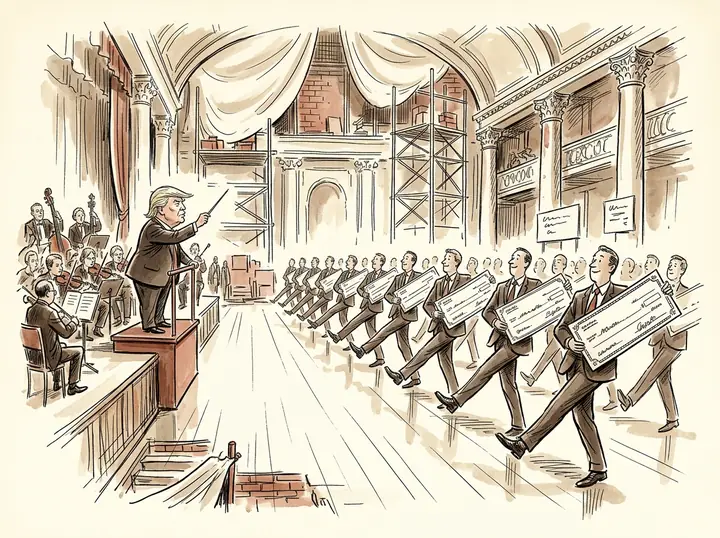
The Washington Post has named the private donors behind about $330 million for President Donald Trump’s new White House ballroom, Democracy Now reports. Nvidia and Apple gave $25 million each and Comcast $7.5 million, alongside Amazon, Microsoft, Caterpillar, T-Mobile and several cryptocurrency companies. A ballroom, by design, is where everyone moves to the same music.
Senator Bernie Sanders wrote on 16 October that when Democrats regain control of Congress “we must raise the minimum wage to at least $20 an hour.” The federal floor is still “$7.25 per hour,” unchanged for 17 years, and AAA put regular gas at $4.3271 a gallon that day. The minimum wage is now old enough to drive, though not far.
The Government Accountability Office audits Washington, and its own inspector general tells Congress that “There were no attempts by GAO to resist, object to, or interfere with OIG independence.” The same report asks for dedicated budget authority, “similar to that of over 50 other OIGs.” Nobody has interfered, and the inspector general would like a budget line in case someone starts.
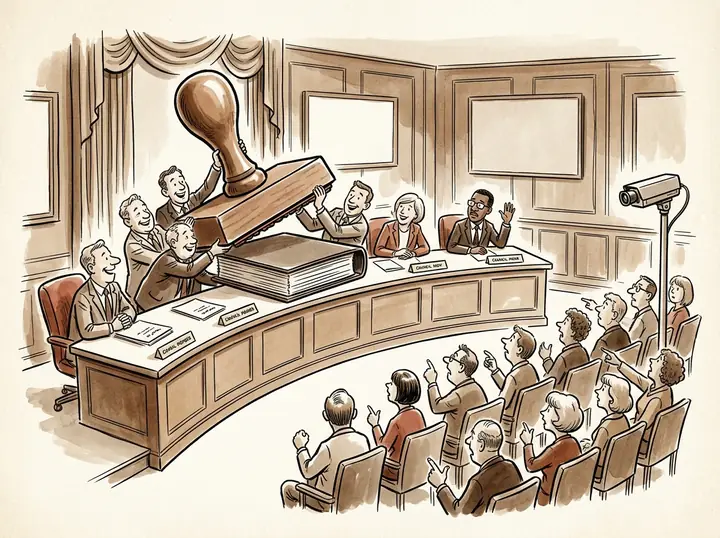
Bloomington, Indiana, has passed a $164.9 million operating budget for 2027. The lone vote against came from Council President Isak Asare, who said that “for too long, council has just been a rubber stamp on a lot of things.” Public comment ran for hours on license plate readers; nobody from the public spoke on the budget. The stamp came down six to one.
The Government Accountability Office has examined the Department of Housing and Urban Development, which cut its workforce by 29 percent in 2025, mostly through deferred resignations. Nearly all of the 20 housing groups GAO interviewed said their experienced points of contact had left. HUD did not respond to GAO’s requests for information throughout the audit. The auditors, too, could not find a point of contact.
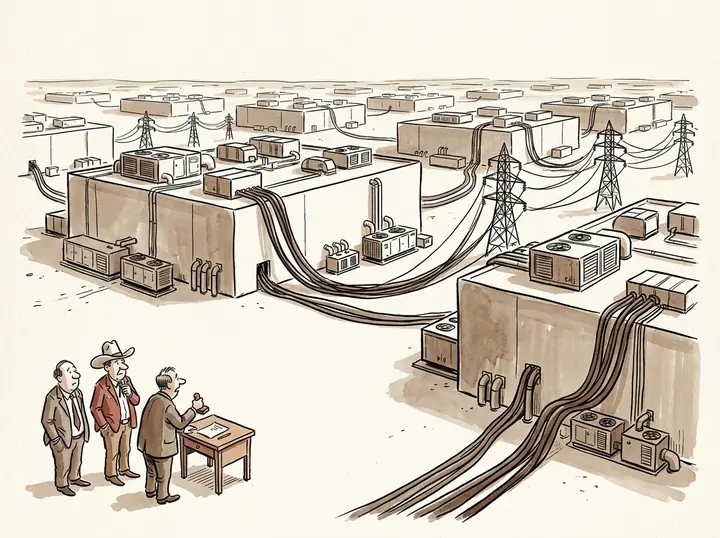
Harris County, Texas, has 46 operating data centres and at least six more in development, and the local utility projects 8 gigawatts of new data centre demand around Houston by 2029. The county attorney says peak demand could rise by about half. “The short answer right now is the county has little to no authority to stop them,” said Commissioner Lesley Briones. Half again as much power, and none of it the county’s.
Katie Zacharia began as White House press secretary on Monday and held one briefing, on Tuesday: about 14 minutes, with questions from three reporters. By Friday she was leaving the job, after President Trump said he had told her, “Honestly, if I were you, I’d reconsider,” and that she was “better off being happy.” He added that “a lot of people” wanted the job. Four working days, one briefing, three questions, and even the departure was announced by someone else.
Texas’s Democratic Senate candidate raised $64 million in a quarter, a claimed Senate record, more than $134 million in all, vowing to “end billionaire control over our politics.” His Republican rival raised $18 million, helped by at least $10 million a billionaire put into a supporting super PAC, on top of $158 million that billionaire gave the party in September. The race to remove money from politics is the most expensive in the state.
In the United States, donors and groups who want artificial intelligence regulated have spent nearly $50 million on this election cycle, Axios reports. Guardrails Alliance alone has raised $11.7 million. Leading the Future, a super PAC backed by tech executives and investors, had more than $31 million on hand at the end of the second quarter. The industry has found a new market: elections about itself.
The 119th Congress has passed 121 public laws, the second fewest in four decades, and 12 of them are ceremonial; earlier Congresses averaged about 440 by Election Day. Pew notes the lame-duck session “may boost Congress’ productivity numbers considerably.” The legislature does its best work once the voters have finished with it.
The Senate convened at 3:30 p.m. on October 13 and 9:30 a.m. on October 15, and on each occasion, the record states, “no business was conducted.” The next session, on October 19, has “no business expected.” These pro forma sessions continue until November 5. The chamber meets diligently, so as not to be caught in recess.
Chicago’s City Council voted 33 to 17 to override the mayor’s veto of an ordinance that would have required 30 votes, instead of 26, to borrow money. It needed 34. Debt and pension payments already take about 40 percent of the city’s operating budget. The council could not muster a supermajority to make supermajorities necessary.
Ohio’s governor signed an executive order letting the state’s colleges give athletes from the high-school class of 2022 a fifth season, against NCAA guidance. “When the rules change, fairness has to remain part of the equation,” he said. The NCAA’s president replied that he “cannot legislate NCAA eligibility rules.” College sport now has two referees and one ball.
In his own $10 billion lawsuit against the BBC, the president’s lawyers cancelled his October 16 deposition, citing “other matters of national importance,” and offered January, after discovery closes. The broadcaster’s counsel called him “the most central figure in this case: Plaintiff himself.” The plaintiff is very keen on the case, as long as it proceeds without him.
Nearly $22 million in public money has paid for pro-administration “patriotic” adverts since late September, an NPR analysis found, nearly $10 million of it after the president posted on October 5 that he would “pay for them myself” through his super PAC. A judge ordered the slots cancelled; hundreds more aired overnight, and the White House said it “did not receive notice from the court in time.” Each ad ends, accurately, “Paid for by the U.S. Government.”
North Carolina has suspended its 41-cent gas tax until November 30, three weeks after the election, at a cost of about $360 million from an inflation reserve. Lawmakers rejected an amendment letting the attorney general make sure the savings reach drivers. The governor said acting “four weeks before an election” was “not enough.” The relief has a firm end date and no firm recipient.
The deputy director of the budget office is reportedly under consideration to lead the Government Accountability Office, which rules on the legality of the budget office’s work, for a 15-year term. The bipartisan commission that must recommend candidates has not met in the nine months since the post fell vacant. One staff member said the system now relies “on agencies to tattle on themselves.” The tattler, in this plan, would also be the teacher.